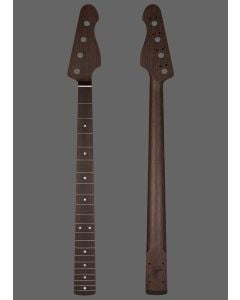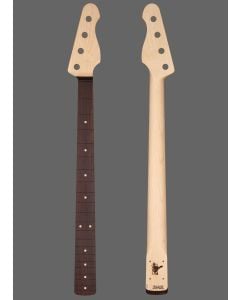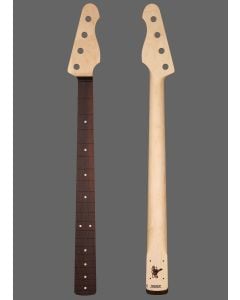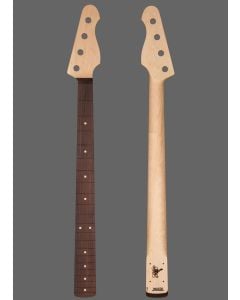


Wood necks are not sufficiently strong to withstand the constant tension of steel guitar strings. To counter this string
tension, steel reinforcement devices have been developed. This device not only strengthens the wooden neck but is
also adjustable. Because of their engineered shape or design, these devices are called truss rods.
As with many devices, there is ongoing refinement and new methods being researched. However, for the conservative minded
or traditional player, there are two primary truss rod designs in common usage. Both of these designs are available from Warmoth.
The first and oldest design we call "vintage." This consists of a single rod inset into a concave trench below the fingerboard.
It is anchored to the neck at both ends. This is the rod used by both Fender and Gibson. Warmoth offers this style.
The second design is a double rod, either made of two pieces welded together or a folded single piece. This rod is laid in a
straight trench below the fingerboard and it is not anchored to the neck. This design has been used by Rickenbacker for many years. Warmoth offers this style also.
A third design now enjoying some popularity is a variation of the vintage single rod which is adjustable in two directions. While
this design is touted to be superior, it is our opinion that well designed necks built from carefully selected and cured woods exhibit
none of the problems this design is proported to solve. Warmoth does not offer this style.
Which design is right for you? This is a personal choice with no wrong answer. To precisely replicate vintage tone,
only the vintage rod will do. For stability and better sustain, only the double rod delivers. Which are the most important features to you?
Vintage Guitar Neck Truss Rod
This single rod is typically 3/16" in diameter and threaded 10-32. One end is a fixed anchor, the other end is an adjustable anchor.
Key to the function of this rod is the concave slot or trench in which it is installed. Tightening the adjusting nut causes the rod
to straighten thereby exerting upward pressure in the middle of the arc.
The red arrows indicate the compression forces exerted lengthwise upon the neck. The blue arrows indicate the forces bearing up on
the center of the neck. The yellow arrows indicate the resulting neck movement determining string action height and corresponding relief.
Benefits of the vintage truss rod
- Light weight minimum mass
- Unique tone replicates vintage tone
- Less torque required for adjustment
- Top adjusting on Vintage Modern necks
Drawbacks
- Requires frequent adjustments with seasonal humidity changes
- Compression of the wood lengthwise causes eventual wood distortions (lumps and bumps in the fretboard)
- More difficult installation with fitted skunk stripe
The Double Expanding Truss Rod
for Warmoth Guitar Necks
The double rod is installed directly under the fretboard in a straight trench approximately 3/8" deep. A long adjusting nut is used to
focus the truss action away from the unmovable heel joint.
When flexed in the neck, resulting pressures are shown above. The blue arrows show the two rod ends exerting strong downward forces while
the middle pushes up uniformly. The resulting neck movement shown with the yellow arrow, determines string action height and corresponding relief.
The force exerted by the tail end of the double rod is considerable. There must be a minimum 1/8" of wood below the rod end to prevent
wood failure in this area. This becomes a concern only when thinning a neck beyond factory engineered dimensions. All Warmoth Pro necks exceed this engineering requirement.
Benefits of the double expanding truss rod
- Extremely stable, no seasonal adjustments are necessary
- Increased mass = longer sustain, cleaner and clearer tones
- No end to end wood compression to eventually distort the neck
- Heel adjusting on most necks
- Top adjusting on 13° Angled necks
Drawbacks
- Weighs 3 ounces more than a vintage rod
- More torque required for adjustment
- More expensive to manufacture