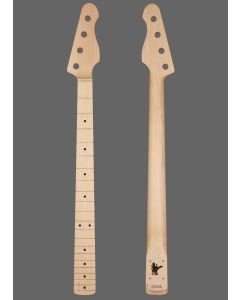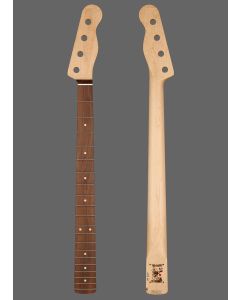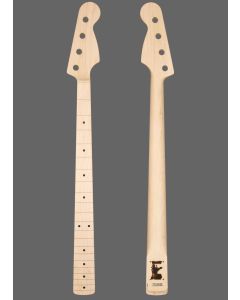



Guitar Neck String Nut Options
The string nut is what dictates both the spacing (or pitch) of the strings and their height above the frets. This is a critical
component in the action of the instrument. Each string nut must be cut to the specific dimensions of the neck it
will be used on.
|
Guitar Neck String Nut Materials |
| Materials |
Characteristics/Applications |
Sound |
Workability |
| Bone: |
Hard material with a vintage look, must be cut cleanly to keep strings from binding in slots. |
Bright and clear, with a detailed sound. |
Hard, dense material. Bad-smelling dust. |
| Brass: |
Hard material polishes well and looks good with gold hardware.
Great sustain for bass and slide guitar playing. |
Bright with very good sustain. |
Slow-working, dust can clog files, gets hot when power-sanded. |
| Nickel: |
Made of the same material as our fretwire (18% hard nickel/silver)
so it matches sound & look of frets. Polishes well. |
Very bright with excellent articulation and sustain. |
Very slow working, gets hot when power-sanded. |
Graph Tech TUSQ: |
A Graph Tech proprietary material which is precision engineered under high pressure and heat. It is specifically formulated to deliver an optimum sonic transfer rate. Stringent production methods create consistent material that is rich in tone and harmonic content. Standard TUSQ will have a slightly brighter sound than the Black TUSQ XL. |
Evenly balanced tone. |
Easy to cut, less shaping required with pre-molded blanks. |
Graph Tech Black TUSQ XL: |
Black TUSQ XL is a similar material to standard TUSQ but is also Teflon impregnated. Teflon is 500% slipperier than graphite. This is great for use on electric guitars that get tremolo use or have tuning stability issues. It is also great for someone who bends notes often. |
Well balanced tone with a bit more warmth. |
Easy to cut, less shaping required with pre-molded blanks. |
| Corian: |
Hard synthetic material takes a fine finish and is available in large oversized blanks. |
Balanced, clear, even sound. |
Cuts slowly but evenly. |
Precut & Installed NutsPrecision cut for your specific neck |
We have built a system for precision cutting nuts to fit our necks. The cutting and shaping is
done by a bench top CNC mill. Every nut is custom cut to the specific neck dimensions with the result being a nearly perfect nut, compensated for fret height, nut width, fingerboard radius, etc. Nuts must be ordered at the same time as the neck to insure compatibility.
White Corian $25.00
Graph Tech TUSQ $30.00
Graph Tech Black TUSQ XL $30.00
* These installed nuts are only available for new Warmoth neck orders.
|
Earvana Precut and Installed Compensating Nut |
In partnership with our friends at Earvana, we can now offer an Earvana designed Compensating Nut custom cut and installed on your new Warmoth neck! Earvana's innovative design enables a guitar to play more in tune all over the neck!
We begin by cutting a wider nut slot in the neck as we would for an LSR roller nut, then take careful measurement of the installed fret size and neck width. Our custom nut milling machine cuts the slots at the correct depth and spacing for that neck.
Any Warmoth Pro or Vintage Modern straight headstock necks, except Mustang
Right or left handed
Available Materials: White Corian $65.00 Graph Tech TUSQ $69.00 Graph Tech Black TUSQ XL $69.00
|
Earvana nut installation requires cutting the nut slot wider, towards the 1st fret. |
 |
Earvana Retrofit Compensating Guitar Nut |
 |
Earvana nuts fit the existing nut slot, no neck modifications necessary. |
 |
|
This nut is easy to install yourself and requires no modifications. The Earvana Nut compensates for fretting stretch
on the strings at the nut. It improves intonation and enables you to sound any note, in tune, anywhere on the fingerboard. It's
also flexible enough to work with any fretboard radius.
Available in Ivory or Black. All hardware and instructions included.
1-5/8", 1-11/16", 1-3/4", Fender® Style Compatible, or Gibson® Style Compatible.
We do not install these Earvana retrofit style nuts
|
LSR Roller Nut |
|
This ingenious nut uses ball bearings to locate the strings and ease their movement across the nut. When used
in conjunction with locking tuning machines and moderate tremolo action, tuning issues are significantly reduced
when compared to more conventional set-ups.
Installation of the LSR nut requires widening the nut slot towards the first fret to 7/32". Therefore, if you wish
to change from this nut to a conventional nut, the old slot must be filled in this area. This can be cosmetically
unappealing and costly so it's a good idea to be sure that you like the LSR nut before having a neck set-up for it.
|
 |
LSR nut
installation requires cutting the nut slot wider, towards the 1st fret. |
 |
- 1 11/16" nut width and right handed only
- Satin chrome only
- Recommended for our compound radius necks or necks with fingerboard radius of 9 to 10 inches.
- Not available on tiltback necks.
Neck Preparation for the LSR nut - $45.00
|
Schaller Floyd Rose Locking Nut Prep |
 Straight Installation |
 13° Angled Neck Installation |
 Rear View |
|
The ultimate locking nut secures the strings within the nut. Use in conjunction with a locking bridge for a dive bomb ready system.
These nuts feature a 10" radius. Ideally, the fingerboard radius ideally should be 10" but we have found it to remain
functional between 9" and 12".
There are many licensed locking nuts available, all employing the same design principal but not the same dimensions or radius.
Warmoth only offers lock nut preparation for the Schaller made nuts.
These nuts are included with both the "Original" and the "Schaller" Floyd Systems and are also sold separately in our Hardware
section. Click here to go there now!
- Available on Warmoth Pro construction necks only
- We must know the R or L number of your nut
Straight Neck Prep - $45.00
13° Angled Neck Prep - $55.00
|
Width Dimensions |

Chrome
Black
Gold
|

These nuts are easily identified by the "R" number located on the bottom or in the case of left hand nuts it is an "L" number.
|
| Right Hand |
Left Hand |
|
R-2 = 1-5/8" Nut-Width
* R-3 = 1-11/16" Nut-Width Narrow
R-4 = 1-11/16" Nut-Width Wide
R-5 = 1-3/4" Nut-Width
|
L-2 = 1-5/8" Nut-Width
* L-3 = 1-11/16" Nut-Width Narrow
L-4 = 1-11/16" Nut-Width Wide
L-5 = 1-3/4" Nut-Width
|
|
*R3 &
*L3 = 1 11/16" Nut Width Narrow
Essentially, this nut is the 1 11/16" width, but the spread of the strings is pulled
in resembling the spread found
on a 1 5/8" nut.
|
Player Tips:
- R3 & L3 nuts work well with necks that have a 1 11/16" nut width and that are also bound. They are also popular with players wishing for a little more fret margin so as not to bend the strings beyond the fret ends.
- Light trem user? Check our the graphite nut or LSR nut
- Like to dive bomb? Go locking nut!
Tech Tips:
- There is a popular misconception that one may buy generic nuts to fit existing necks. If optimum results are
expected, this simply is not so. A nut must be cut to specific geometric parameters to function properly and these
parameters are dictated by the type of neck it is to be used on and the angle with which the strings break from the nut towards
the individual tuners.
- For fine adjustments to your nut slots use our File Set NFS8
|
|